
The Part of the Job AI Can Actually Take Over
A working press photographer spends far less time photographing than most people assume. A single assignment can produce eight hundred frames, and what follows is selection, captioning, keywording, processing, export and delivery. It is the part of the job that is invisible to clients, unpaid in most fee structures, and done at the end of a long day when concentration is lowest.
That is exactly where the current generation of software helps. Automatic selection, subject recognition, keyword suggestions, masking, noise reduction and upscaling have all moved from novelty to routine inside ordinary cataloguing and editing programmes. None of these functions makes a picture. All of them shorten the distance between the card and the filed set.
The useful distinction is simple, and it holds up far better than a blanket position for or against the technology. Tools that help you find, organise and present what you photographed are assistants. Tools that add, remove or invent content are something else entirely, and in editorial work they are mostly off limits. A photographer who keeps that line clear can use everything on the useful side of it without hesitation, which is a considerably more productive position than refusing the whole category.
Culling: Letting the Machine Make the First Pass
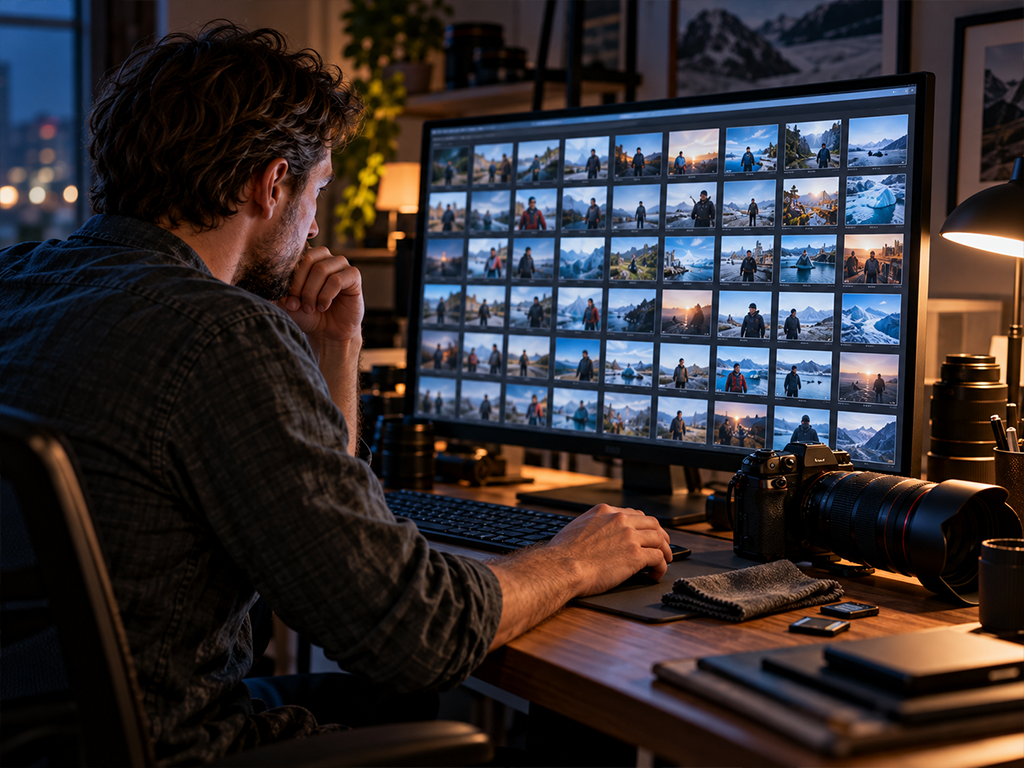
Selection is the most obvious place to start, because it is mechanical before it is creative. Software can now reliably mark frames that are out of focus, flag closed eyes, group near identical bursts and rank images by technical sharpness. On a set of eight hundred frames from a two hour assignment, that first pass takes minutes and removes perhaps half of them from consideration.
What it cannot do is choose the picture. Technical quality and editorial value are different things, and the frame that tells the story is often not the sharpest one. The moment a hand is raised, an expression breaks, two people in a crowd look at each other: no ranking algorithm recognises meaning, because meaning depends on what the story is about, and the software does not know that.
The workable routine is therefore a two stage edit. Let the machine remove the technically unusable, then make every further decision yourself, looking at full frames rather than thumbnails. Treat automatic ratings as a filter, never as a shortlist, and check the rejects before deleting anything, because unconventional frames, motion blur used deliberately and unusual compositions are precisely what automatic scoring tends to mark down.
Keywording and Captioning Without Inventing Facts
Keywording is the task photographers postpone most and regret most. Automatic subject recognition genuinely helps here: it identifies objects, scenes, colours and often people from a face catalogue you have built yourself, and it writes them into the metadata in seconds. For archive work and stock submissions, the time saved over a year is measured in days.
Captions are a different matter, and this is where the real risk sits. Recognition software describes what an image appears to contain. It does not know where the photograph was made, when, who the people are, or what was happening. Generated caption text reads fluently and confidently, and it will produce a plausible sentence about a scene it has misread entirely. A caption that says “protesters outside the city hall” when the building is a courthouse is not a small error, it is a correction notice and a damaged relationship with the desk.
The sound practice is to let the software supply the vocabulary and keep the facts yourself:
- Automatic keywords are suggestions to review, not a finished field. Delete what is wrong and add what the machine cannot see, such as the event, the organisation and the context.
- Names, places, dates, times and figures are written by the photographer, from notes made at the scene.
- Anything you did not witness is attributed to the source that provided it.
- Location data from the camera is checked rather than trusted, because a phone or body with a weak fix can be out by a considerable distance.
Used that way, the tools remove the drudgery of describing an image and leave the responsibility for what it claims exactly where it belongs.
Where Processing Ends and Manipulation Begins
Photographers have always processed images. Dodging, burning, cropping, contrast and colour correction are older than digital photography and entirely legitimate. The newer tools make these adjustments faster and more selective: a sky can be isolated without a manual mask, a subject separated from its background with one click, noise reduced at ISO values that were unusable a few years ago.
The line that matters has not moved at all. Adjustments that change how a photograph looks are processing. Adjustments that change what it shows are manipulation. Removing a lens flare is processing. Removing a bystander, a rubbish bin or a second police vehicle is manipulation, regardless of how convincingly the software fills the gap. Selective brightening is processing. Replacing a dull sky with a dramatic one is manipulation. The tool being automatic does not change which side of the line it sits on, and generative fill does not become acceptable because it is built into the same panel as the exposure slider.
Several of these functions are now switched on by default, which is the practical danger. Automatic distraction removal, sky replacement suggestions and content aware healing can alter an editorial image without a deliberate decision, so it is worth checking what your software does on import and turning those features off for news work. Keeping the untouched original file alongside the processed version is the simplest protection you have: if a picture is ever questioned, the raw file settles it.
Those standards are not a personal preference. They follow directly from the principles of truthful reporting set out in the IAPP Code of Conduct, which binds the accuracy of the published record to the credibility of every member who works under it. The craft side is worth investing in as well, because photographers who know what their software actually does to a file are far less likely to be surprised by it, and the IAPP webinars and workshops cover professional raw processing and retouching from exactly that angle.
Generative Tools and the One Rule That Protects Your Byline
Generative image tools are a legitimate part of commercial, advertising and illustrative work. In journalism they are not, and the distinction is absolute rather than a matter of degree. A photograph published as news is a statement that this happened, in this place, in front of this camera. Any generated element inside the frame makes that statement false.
The practical rule is one sentence long: nothing may enter the frame that was not in front of the lens, and nothing may leave it. That covers generative expand, which invents image area beyond what you photographed, as well as object removal and the addition of people, weather or detail. It applies to the crop that was too tight, to the distracting sign at the edge, and to every other case where the temptation is strongest because the fix is now so easy.
There are two reasonable exceptions, both well established and both requiring transparency. Illustrative images that are clearly labelled as illustrations, for example a generated concept image accompanying an opinion piece, are not news photographs and are not presented as such. And technical restoration of damaged archive material is a repair of an existing image rather than an invention. Everything else belongs in the commercial half of your portfolio, kept visibly separate from editorial work.
Photographers sometimes treat this as excessive caution. It is not. One generated element discovered in one published news photograph ends a career, because the question it raises is not about that frame, it is about every frame the photographer has ever filed.
Proving the Picture Is Real: Metadata and Disclosure
As generated images have become harder to identify by eye, the burden has shifted from spotting fakes to proving authenticity. For working photographers this is good news, because provenance is something they can supply and an anonymous generated file cannot.
Most of it is ordinary discipline. Keep the original raw files with their camera metadata intact, including the time, the camera body and the lens. Export derivatives rather than overwriting originals. Make sure your name, copyright and contact details are embedded in the file rather than only in the delivery email. Keep the field notes that support your captions. Taken together, that is a chain of evidence that answers almost any challenge to an image within minutes.
Alongside this, a technical standard for content credentials is being built into cameras and editing software, recording an image’s origin and the edits applied to it in a signed, verifiable form. It is still arriving unevenly across manufacturers and publications, and it deserves an article of its own, but the direction is clear enough to act on now: photographers who already keep clean originals and honest metadata will adopt it without changing anything about how they work.
Disclosure completes the picture. If you used generative tools on a commercial image, say so. If a client asks what was done to a file, answer precisely. Professional certification such as the Certified Press Photographer qualification works in the same direction, because it attaches a verifiable professional standard to the name on the credit line, which is worth considerably more in an era when any image can be fabricated.
What Editors and Agencies Now Expect in Writing
Policies that were informal two years ago are now written into contracts. Most wire services and serious publications require that no generative element appears in editorial images, that processing stays within the limits of traditional darkroom adjustment, and that raw files can be produced on request. Some require a declaration with every submission; stock libraries increasingly ask contributors to label AI assisted material and to confirm that keywords and captions are accurate.
Read these terms before you submit rather than after a query arrives. Three questions cover most situations: what processing is permitted, whether any AI assistance has to be declared, and whether you must retain and supply originals. If a client has no written policy, propose one in your own delivery note. A short line stating that images are unmanipulated, that adjustments were limited to exposure, colour and cropping, and that raw files are available on request costs nothing and sets you apart from suppliers who cannot say the same.
This is also where professional structures pay off. Photographers publishing through association channels work to standards that are agreed in advance rather than negotiated per job, which removes the ambiguity from the transaction. For members, contributing work through the IAPP network means submitting into a system where the expectations around accuracy and authorship are already established on both sides.
Using the Tools Without Becoming Replaceable
The fear that software will replace press photographers misreads what the work consists of. No model can be present at an incident, earn the trust of someone who has just lost their home, hold a position on a touchline for ninety minutes, or make the judgement about which frame is honest. What software can do is remove several hours of sorting, tagging and cleaning from every assignment, and a photographer who refuses that help on principle is simply working more slowly than the photographer next to them.
What protects a career is not avoiding the tools but being demonstrably accountable for the result: clean originals, accurate captions, processing you can explain, a clear line you do not cross, and credentials that can be checked. Those are the assets a generated image will never have. IAPP membership is built around that side of the profession, from a binding code of conduct and recognised credentials to training and publishing routes, and all of it has become more valuable rather than less as the technology has improved.
Let the machine do the sorting. Keep the judgement, the facts and the responsibility yourself. That division of labour has not changed since the darkroom, and it is still the whole of the job.