
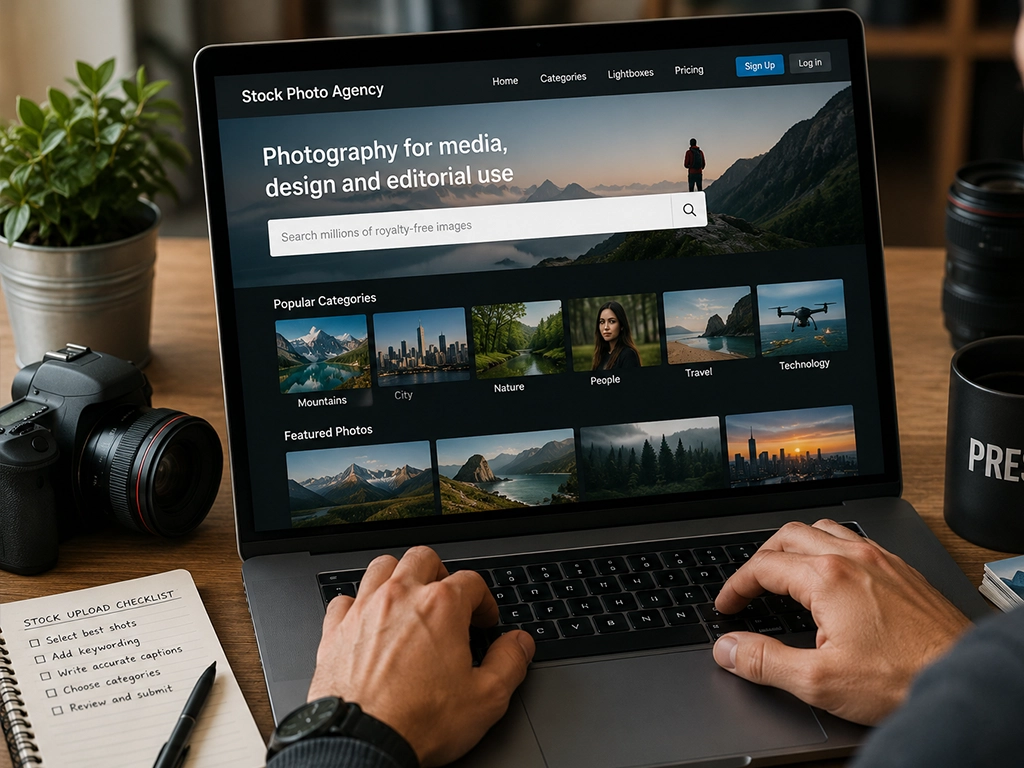
Most press photographers are paid once for a photograph that could earn for years. The difference between a shoot fee and a sustainable income lies in what happens to an image after the assignment ends: how it is licensed, where it is placed, and who is allowed to use it under what terms. This guide explains the practical mechanics of licensing, stock, and syndication, and how to build revenue from work you have already produced.
Why Great Photographs Rarely Pay by Themselves
There is an uncomfortable truth at the centre of professional photography: skill and income are only loosely connected. Excellent photographers go unpaid every day, while less gifted ones earn steadily. The variable is almost never talent. It is commercial literacy, the understanding of what is actually being sold when a photograph changes hands.
Many photographers think of themselves as selling pictures. They are not. They are selling permission. Copyright in an image belongs to the person who created it, and what a client buys is a licence, a defined right to use that image in a particular way, for a particular period, in a particular place. The photograph itself never leaves your hands. That distinction sounds academic until you realise its consequence: the same file can be licensed to a magazine, a website, a textbook publisher, and an exhibition, each time for a separate fee, without ever being sold in the everyday sense of the word.
The scale of what goes unclaimed becomes clear once you look at a typical archive. A working press photographer might return from a single year with tens of thousands of frames, of which perhaps a few hundred were ever published and paid for. The rest are not failures. Many are perfectly licensable images of identifiable places, events, and subjects that somebody, somewhere, will eventually need. They earn nothing purely because no route exists between them and a buyer, and because their owner never treated them as inventory.
This is what separates a photographer with a job from a photographer with a business. The first is paid for time. The second is paid for time and then keeps being paid for the asset that time produced. Building the second model does not require different pictures. It requires a different understanding of what you own and a system for putting it to work.
Understanding What You Actually Sell
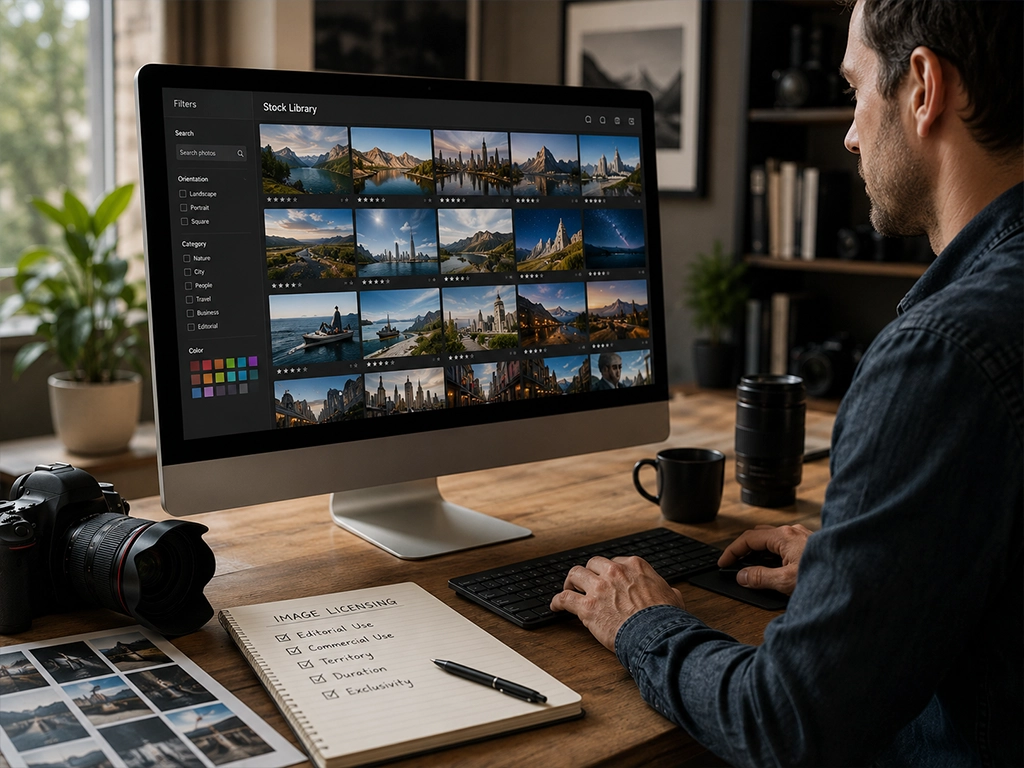
Every licence is defined by a handful of variables, and being fluent in them is the foundation of everything that follows. The most important are the type of use (editorial, commercial, internal), the medium (print, web, broadcast, advertising), the territory, the duration, and whether the licence is exclusive or not. Change any one of those and the value of the licence changes with it. A regional newspaper running a photograph once online is buying something very different from a global brand using it in a campaign for three years.
Two models dominate the market. Rights-managed licensing prices each use individually according to those variables, which means higher fees and tighter control. Royalty-free licensing sells broad usage rights for a single low payment, trading control and price for volume. Neither is inherently better, but confusing them is expensive. It is also worth knowing that editorial licensing, which covers news and illustrative use, does not require model or property releases, whereas commercial licensing usually does. Many photographers unknowingly limit their own market by never obtaining releases when they easily could have.
One rule sits above all others: do not sign away your copyright. Contracts occasionally ask for a full transfer or a broad “buyout” in exchange for a modest fee, which ends any future income from that image permanently. Reading contracts carefully is part of the profession, and members can draw on the association’s internal information and research section on media rights through the IAPP benefits overview when a clause is unclear. A single unread paragraph can cost more than a year of assignments.
The Stock Route and Its Realities
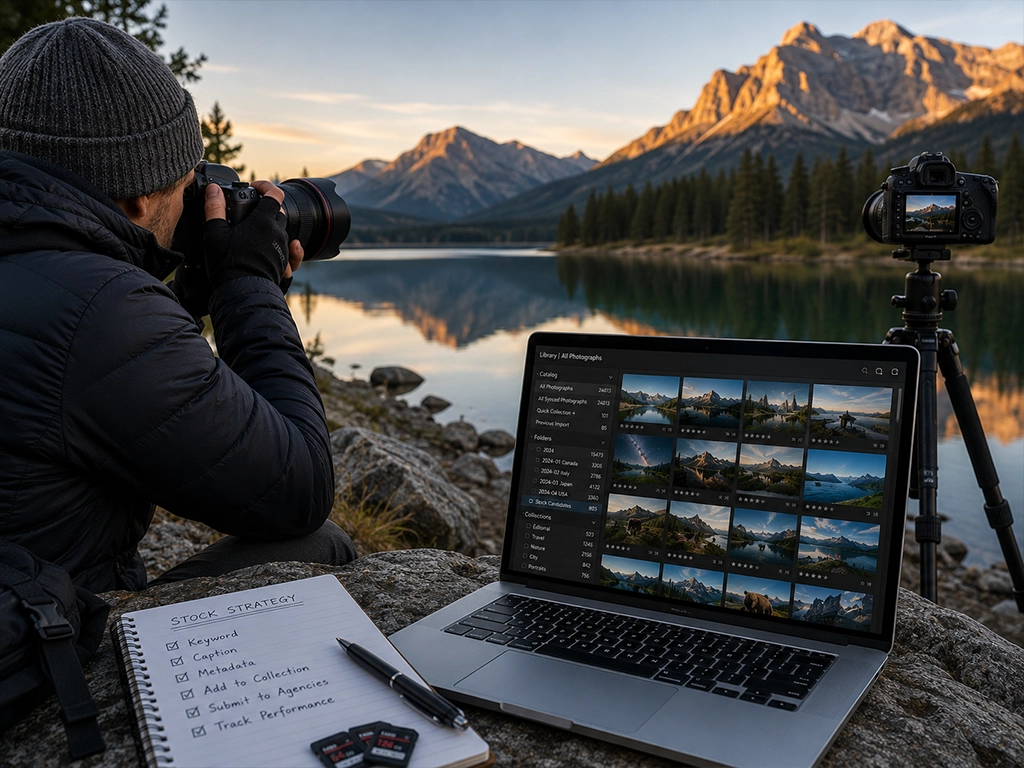
Stock photography is the most familiar route to passive income and the most frequently misunderstood. The model is simple: you place images with an agency, the agency markets and licenses them, and you receive a percentage of each sale. The appeal is obvious, since work already sitting on your drives can start earning without further effort.
The realities deserve equal attention. Commission rates vary widely, and on high-volume platforms a single licence may return only a small amount, meaning income depends on scale rather than on individual sales. Editorial stock, which is where most press photography belongs, is a narrower but less crowded market than the generic commercial imagery that dominates the large libraries. Success there comes from supplying material that genuinely is not already available: specific events, identifiable locations, regional stories, and subjects with news value.
Approached seriously, stock rewards a few disciplined habits:
- Caption and keyword every image accurately, because unfound files never sell.
- Submit consistently rather than in occasional large batches.
- Study what your chosen agency actually licenses before deciding what to upload.
- Keep your strongest exclusive work out of low-return libraries.
Treated as a lottery, stock produces disappointment. Treated as a slow-compounding archive that grows every time you already have a camera in hand, it becomes a genuine second income stream.
Syndication: Selling the Same Image Many Times
Syndication is the quiet engine behind many sustainable photography careers, and it is the natural extension of the licensing principle. Rather than one image serving one client, syndication distributes the same work to multiple outlets, each paying for its own use. A photograph from a single afternoon can appear in a national daily, a trade magazine, and a foreign news site within a week.
The mechanism can be a wire service, a syndication agency, or a press portal that places your work in front of editors who would never find you otherwise. Speed and reliability matter enormously here. News syndication rewards the photographer whose captioned, correctly sized files arrive while the story is still current, not the one whose superior images arrive two days later.
For independent photographers the hardest part is distribution reach, since an individual simply cannot contact every relevant outlet. This is where association infrastructure earns its keep. IAPP members can market their articles and photographs through partner services and maintain an online portfolio that puts their work in front of editors and clients, as set out among the reasons to join the IAPP. Distribution is not a substitute for quality, but quality without distribution simply sits on a hard drive.

Direct Licensing and the Case for Cutting Out the Middle
Agencies and platforms provide reach in exchange for a share of the revenue, sometimes a very large share. Direct licensing reverses that equation. When a client comes to you and you issue the licence yourself, you keep the entire fee and you control the terms. It is the highest-margin income in photography and, for most working photographers, the most reliable.
Direct clients are more varied than people expect. Publishers, agencies, museums, tourism boards, corporate communications departments, NGOs, and local businesses all need images and often prefer dealing with a person rather than a library. Many of them will license an existing photograph rather than commission a shoot, simply because it is faster and cheaper. Your archive is therefore a catalogue, and the only thing standing between it and revenue is discoverability plus a willingness to be contacted.
Making that possible is mostly a matter of being findable and easy to deal with. A portfolio that shows what you cover, captions that state where and when an image was made, and a licensing enquiry route that a busy picture editor can use in under a minute will convert more work than any amount of cold pitching. Photographers who publish their material where editors already look, rather than only where colleagues do, tend to receive enquiries they never had to chase.
The skills involved, pricing a licence, writing a clear usage agreement, invoicing, and negotiating without conceding your rights, are learned rather than innate, and they are exactly what most photographic training omits. Structured professional development helps close that gap, and the association’s seminar on marketing your press photos, listed among the IAPP webinars and seminars, addresses the specific question of selling your images while retaining the bulk of the royalties yourself.
Pricing Without Undercutting Yourself
Nothing damages a photographer’s income more reliably than mispricing, and the damage runs in one direction. A low fee, once accepted, becomes the reference point for every subsequent negotiation with that client and often with the ones they talk to.
Price by usage rather than by effort. Clients do not care that an image took four hours in the cold; they care what the picture will do for them. A photograph used on a company’s home page for two years is worth substantially more than the same photograph used once in a newsletter, and pricing should reflect the value delivered rather than the labour expended. Where a fee must be reduced, reduce the licence with it. Narrow the territory, shorten the duration, or remove exclusivity, so the discount buys something instead of simply devaluing your work.
Two habits protect you over time. Put every agreement in writing, however small, because verbal licences are unenforceable and endlessly disputed. And be wary of exposure offered in place of payment. Genuine visibility occasionally has value, but it is not currency, and the outlets that offer it most enthusiastically are rarely the ones that generate income later.
Protecting the Asset You Are Selling
An income built on licensing depends entirely on your ability to prove what you own and to find out when it is used without permission. That protection begins at the moment of capture and costs almost nothing.
Embed your authorship, contact details, and licensing terms in the metadata of every file you release, and keep the untouched originals archived with their capture data intact. Caption accurately and consistently. Maintain a simple record of what was licensed to whom, on what terms, and when the licence expires, because expired licences are one of the most common and most recoverable sources of unpaid use. Reverse image searches will show you where your work has travelled, and most unauthorised use turns out to be careless rather than malicious, which means a professional invoice often resolves it faster than a legal threat.
Verifiable professional standing strengthens every one of these conversations. A photographer who can demonstrate registered credentials and certification is taken seriously by a legal department in a way that an anonymous complainant is not, and the association’s CIPP certification, explained in the IAPP FAQ, exists precisely because the title “press photographer” is otherwise unprotected and can be claimed by anyone. Being demonstrably who you say you are is not vanity. It is leverage.
Building an Income That Outlives the Assignment
Licensing, stock, syndication, and direct sales are not four separate careers. They are four channels for the same asset, and photographers who build a stable living almost always run several of them at once, so that a quiet month in one is covered by another. The archive keeps working while you sleep, and every new assignment adds to it.
What makes that model function is rarely a single spectacular image. It is the unglamorous infrastructure around the work: clean metadata, honest captions, written agreements, a distribution route to editors, credentials that prove who you are, and enough commercial literacy to price a licence without apology. None of this dilutes the craft. It is what allows the craft to be practised full time instead of squeezed around other work.
If you are producing publishable images and want them to generate income rather than sit unseen, the practical step is to build the professional framework around them: recognised credentials, a visible portfolio, distribution through partner platforms, and training aimed squarely at selling your work. You can put that framework in place by choosing to become a member of IAPP. You already own the photographs. The question is how many times you intend to be paid for them.